

The 2026 running back class looks like the 2024 class, though there’s a first-round talent in 2026. In 2024, there were around six running backs projected as Day 2 selections, none on Day 1. In 2024, there were two running backs projected into the first round (Ashton Jeanty, Omarion Hampton), with between six and eight as potential Day 2 picks.
This might be the earliest that we’re examining the NFL Draft prospects for the following season, meaning more updates will be made to the spreadsheet with various inputs. We discussed some of the inputs involved in the adjusted score from the previous year.
There doesn’t seem to be a comprehensive list of which players have declared for the 2026 NFL Draft, so we’re probably missing a few. However, this article focuses on those running backs with projected draft capital in the first round and Day 2. There are two running backs that project to be drafted on early Day 3, though we could see them pushed into Day 2, given the lack of talent depth.
2026 First-Round Running Backs
Jeremiyah Love, RB, Notre Dame
Projected Draft Capital: 10th Overall
Jeremiyah Love is the only running back projected for the first round in the NFL Draft, going as a potential top 10 selection. There are three other running backs projected to go on Day 2, with the rest as Day 3 prospects. Interestingly, we have two running backs from Notre Dame and Penn State, potentially top 10 at their position in the 2026 class.
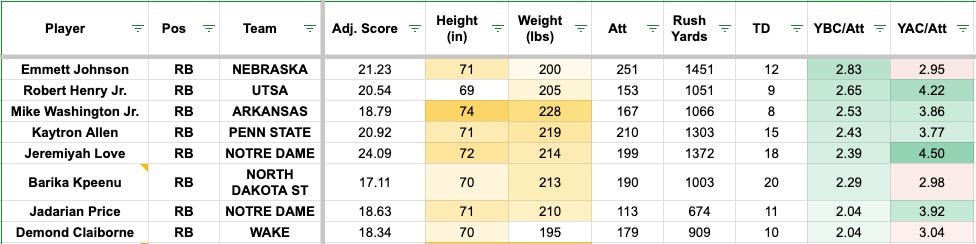
Love posted back-to-back seasons of rushing for over 1,100 yards and scoring 35 total rushing touchdowns. He also caught 55 receptions for over 500 receiving yards over the past two seasons, showing some receiving upside. That’s further evident in Love ranking first among the running back prospects in yards per route run (1.83). Love led the class with 4.50 yards after contact per attempt (YAC/Att) while also generating an above-average yards before contact per attempt (YBC/Att) at 2.39.
The visual below shows the 2026 running back prospects sorted by their adjusted score.

He was a missed tackle machine, forcing a missed tackle on 28.1% of his rush attempts in 2025 and 30.9% throughout his career. Love showed the explosiveness, as one of three running backs in the 2026 class with a 45% breakaway rushing yards rate (percentage of yards going 15+ yards) in 2025 and throughout his career. Those three were Love, Jadarian Price, and Robert Henry Jr. Price played with Love and is a slightly smaller, explosive back.
Some of Love’s early potential comparisons include D’Andre Swift, Josh Jacobs, Javonte Williams, and Mark Ingram based on the production and underlying metrics. However, Love could be one of the rare top-10 selections at the running back position.
2026 Day 2 and Early Day 3 Running Back Prospects
Jonah Coleman, RB, Washington
Projected Draft Capital: 69th Overall
The three running backs with Day 2 projected draft capital include Jonah Coleman (Washington), Jadarian Price (Notre Dame), and Emmett Johnson (Nebraska). Two other fringe running backs with projected draft capital on early Day 3 involve the two Penn State running backs, Nicholas Singleton and Kaytron Allen, which we’ll cover later in the article.
Coleman took a step back from a production standpoint in 2025 after rushing for a career-high 1,053 yards in 2024. He was a touchdown machine in 2025, with a career-best 15 rushing scores, yet Coleman shared the rushing workload with quarterback Demond Williams Jr. and sophomore running back Adam Mohammed.
Williams has been a dual-threat quarterback, handling 31.5% of the team’s rush attempts, taking away rush attempts from Coleman. It’s worth noting that Coleman was dealing with knee and lower-body injuries late in the season, coinciding with a dip in usage and production in 2025.
Meanwhile, Coleman handled 34.4% of the rush attempts with Mohammed at 23.3% in 2025. That’s significantly lower than Coleman’s rushing attempt share (46.3%) in 2024, with Williams only starting in the final two contests. Coleman has shown the ability to fight for yards after contact. He averaged 3.58 YAC/Att in 2025, the lowest since his freshman season at Arizona, while posting a career YAC/Att of 4.12.
Similarly, Coleman had one of the lowest missed tackle rates (20.7%) among the 2026 running back class. However, Coleman had the highest career missed tackles forced per attempt (MTF/Att) rate at 31.2%, ahead of Love. Coleman hasn’t shown the ability to break off massive chunk runs, with a 30.5% breakaway rush rate in 2025, yet a better career average (38.2%). That might indicate Coleman doesn’t possess the high-end straight-line speed, though he’ll be tough to bring down.
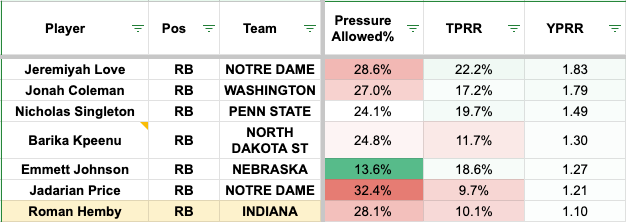
It’s helpful that Coleman was decently involved in the receiving game, posting a career-high in targets (34), receptions (31), receiving yards (346), and yards per route run (1.79), as seen above Coleman had the second-highest yards per route run among the running back prospects, behind Love, as one of five players with a yards per route run of 1.25 or higher. That list includes Coleman, Love, Emmett Johnson, Nicholas Singleton, and Barika Kpeenu. Don’t sleep on the receiving aspect of Coleman’s game.
Jadarian Price, RB, Notre Dame
Projected Draft Capital: 80th Overall
Notre Dame ranked 13th in offensive yards per game, with the 17th-most rushing yards per contest in 2025. With Love at Notre Dame, Price was the secondary option on the team’s backfield. Love handled 48.7% of the team’s rush attempts in 2025, with Price at 27.6%. Price and Love had a heavier share of the running back attempts in 2025. That’s mainly because Riley Leonard accounted for 33.3% of the team’s rush attempts in 2024, with Love (29%) and Price (21.6%) behind him.

Price forced a respectable amount of missed tackles, with 26.5% in 2025. However, we must highlight Price’s explosive ability, leading to a 45% breakaway rush rate, as seen in the visual above. He was hardly involved in the passing game, with 18 targets throughout his collegiate career, translating to a 9% target rate.
That might be because Price had the second-worst pass blocking grade and allowed the most pressures among the 2026 running back class. The only other running back with a worse pass blocking grade involves the mysterious Jaydn Ott.
Price’s best early comparisons don’t look favorable, including DeeJay Dallas, Snoop Conner, Dameon Pierce, and Tyrion Davis-Price.
Emmett Johnson, RB, Nebraska
Projected Draft Capital: 89th Overall
Johnson peaked in his fourth season at Nebraska, finishing his junior year with a Big Ten conference best in rush attempts (251) and rushing yards (1,451) in 2025. Johnson shared the backfield with a sixth-year senior, Rahmir Johnson, and Dante Dowdell in 2024. He posted decent, but not mind-blowing yards after contact numbers throughout his collegiate career, finishing with 2.95 YAC/Att in 2025 compared to a career average of 3.02. However, Johnson was able to generate the highest YBC/Att (2.83) in 2025.
Johnson forced an above-average rate of MTF/Att, yet one of the worst breakaway rush percentages at 27.8% in 2025 and throughout his career. He showed he can handle a heavy rushing workload, though the rushing underlying metrics weren’t in the high-end range. Johnson makes up for it via the receiving game, garnering 95 targets, over 650 receiving yards, and 1.25 yards per route run or higher over the past two seasons.
College Running Backs with 1,200 Rush Yards and 200 Receiving Yards (2023-2025)
2025 (7): Cam Cook, Emmett Johnson, Caleb Hawkins, Jeremiyah Love, Wayne Knight, LJ Martin, Cam Edwards
2024 (10): Cam Skattebointro:
The 2026 running back class looks like the 2024 class, though there’s a first-round talent in 2026. In 2024, there were around six running backs projected as Day 2 selections, none on Day 1. In 2024, there were two running backs projected into the first round (Ashton Jeanty, Omarion Hampton), with between six and eight as potential Day 2 picks.
Early Day 3 Sleepers
Nicholas Singleton, RB, Penn State
Projected Draft Capital: 114th Overall
Kaytron Allen, RB, Penn State
Projected Draft Capital: 117th Overall
Penn State had big dreams heading into 2025. They won three straight against Nevada, Florida International, and Villanova before losing three straight including the Northwestern game when Drew Allar suffered a broken left ankle. Penn State continued to lose three more games, six straight, then closed the season with four straight wins.
They had a tough mid-season schedule, before closing the year averaging 227 rushing yards as a team. Kaytron Allen and Nicholas Singleton have been leading the Penn State backfield for four consecutive seasons, a rare feat in this age of college football. Let’s look at the backfield breakdown from 2023 to 2025.
2023:
Allen: 34% rush share, 37.5% of team’s rush yards
Singleton: 33.3% rush share, 31.3% of team’s rush yards
Allar: 14% rush share, 8.6% of team’s rush yards
2024:
Allen: 36.1% rush share, 34.2% of team’s rush yards
Singleton: 28.2% rush share, 34% of team’s rush yards
Allar: 15.8% rush share, 9.3% of team’s rush yards
2025:
Allen: 44.8% rush share, 57.5% of team’s rush yards
Singleton: 26.2% rush share, 24.2% of team’s rush yards
Allar (six games): 7.7% rush share, 7.6% of team’s rush yards
We saw an even split with Allen and Singleton over the previous two seasons. However, Allen garnered a higher workload while producing most of the team’s rushing yards in 2025. The underlying metrics look more favorable for Allen in most of the rushing categories.
Allen generated 3.77 YAC/Att while averaging 2.43 YBC/Att in 2025. Meanwhile, Singleton wasn’t as effective, with 2.69 YAC/Att and 1.71 YBC/Att. Allen averaged 3.20 YAC/Att in three straight seasons, and we saw spikes by Singleton in 2024 (3.54 YAC/Att) and 2022 (4.58 YAC/Att).

Unsurprisingly, Allen bested Singleton in the percentage of forced missed tackles in 2025 and throughout their careers. Allen boasted a 27.1% MTF/Att in 2025, with 23.6% in his career. Unfortunately, Singleton was at 15.3% in 2025, with a career 17% MTF/Att. We saw the 2025 breakaway percentage in favor of Allen (40.4%), yet Singleton had the better career average (39.8%).
That could hint at Singleton possessing more explosiveness than the underlying metrics suggest. Furthermore, Singleton’s peak seasons in MTF/Att and YAC/Att aligned with the spikes in the percentage breakaway rush yards in 2024 (40.5%) and 2022 (59.9%).
From a pass blocking and receiving standpoint, Singleton might have the edge. He allowed the 62nd-lowest pressure rate among running backs with 25 pass blocking snaps in 2025. Allen was close behind at 67th, though they were within one percentage point in pressure rate allowed in 2025.
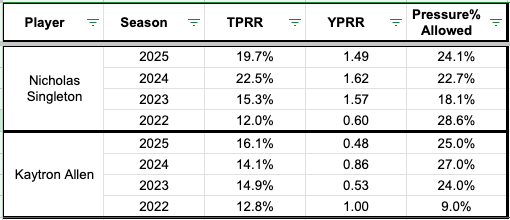
Singleton averaged 1.50 yards per route run in three straight seasons, though we rounded up in 2025 (1.49) while garnering a 17.9% target rate throughout his career. Meanwhile, Allen only produced 1.00 yards per route run in 2022, with the rest under one. Allen had a 14.4% target rate throughout his collegiate career, though he struggled with the receiving efficiency.
We could see Johnson play on passing downs, with the receiving skills. Furthermore, Johnson hardly allowed pressure (13.6%), the lowest among the 2026 running back propsects. Among qualified running backs playing on 20% of the passing plays, Johnson had the lowest pressured rate allowed. That’s a good sign for earning snaps in the NFL.